
Damaged and missing teeth can have a big impact on your dental health and how you feel about your smile. If a tooth is in bad shape, a dental crown can be a helpful solution. A crown is like a custom cap made to fit over a tooth, covering the part you can see. Your dentist might suggest getting a crown if:

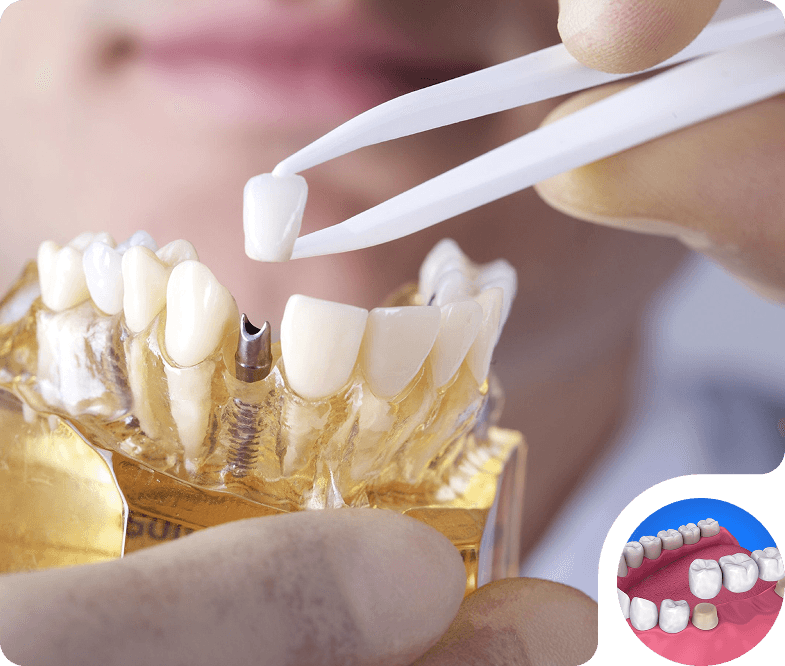
To start the process, we create an impression or a computer model of the tooth we’re working on. Then, we place a temporary crown made of a special type of resin to protect the tooth until the final crown is ready. The new crown is custom-made to ensure it feels just right, matches your other teeth, and doesn’t cause any issues with your bite or jaw movement.
During a follow-up appointment, the dentist carefully checks and adjusts the final crown to ensure it fits perfectly on the tooth. Once it’s just right, the crown is firmly attached using a specific dental adhesive.
To start the process, we create an impression or a computer model of the tooth we’re working on. Then, we place a temporary crown made of a special type of resin to protect the tooth until the final crown is ready. The new crown is custom-made to ensure it feels just right, matches your other teeth, and doesn’t cause any issues with your bite or jaw movement.
During a follow-up appointment, the dentist carefully checks and adjusts the final crown to ensure it fits perfectly on the tooth. Once it’s just right, the crown is firmly attached using a specific dental adhesive.
Find quick answers to common questions about our dental services, procedures, and patient care in our FAQ section.
A dental crown is a custom-made cap that fits over the entire visible portion of a damaged or weakened tooth, restoring its shape, strength, size, and appearance.
Think of it as a protective helmet for a tooth that can no longer function properly on its own. At Excel Dental, crowns are precisely crafted to match the color and contour of your surrounding teeth.
There are multiple crown material options available; you can choose based on your requirement.
We also offer same-day crowns using in-office milling technology—your permanent crown can be designed, milled, and placed in a single visit under 90 minutes.
Traditional crown placement requires two appointments:
A dental bridge literally “bridges” the gap left by one or more missing teeth. It consists of:
The result is a fixed, non-removable restoration that looks, feels, and functions like natural teeth — no implant surgery required.
Both replace missing teeth, but they work very differently:
| Dental Bridge | Dental Implant | |
| How it works | Anchored to adjacent teeth | Titanium post in jawbone |
| Surgery required | No | Yes |
| Bone preservation | Does not prevent bone loss | Preserves jawbone |
| Lifespan | 7–15 years | Lifetime (post) |
| Adjacent teeth affected | Yes—must be shaped | No |
| Cost | Lower upfront | Higher upfront, better long-term value |
We can help you determine which option is best based on your oral health, bone structure, and budget.
The procedure is performed under local anesthesia, so you should feel no pain during tooth preparation. After the appointment, mild sensitivity or soreness around the prepared tooth is common for a few days.
Crowns and bridges are cared for much like natural teeth:
At Excel Dental, we’ve standardized our crown materials based on the functional and aesthetic demands of each tooth position:
Most dental insurance plans cover 50% of the cost of crowns and bridges after meeting your deductible, as they are considered major restorative procedures. Coverage limits and waiting periods vary by plan.
Excel Dental accepts most insurances, including MassHealth.
Here’s what to do:
Don’t have insurance? Excel Dental’s team can also discuss flexible payment options to make your care affordable. Visit ourexceldental.com/patients for more information.
Excel Dental provides crowns and bridges at all 9 Massachusetts locations : Lowell, Lowell (Bridge St.), Billerica, Methuen, Haverhill, Everett, Chelsea, Lynn, and Revere. Same-day crown technology is also available. Open late hours and Saturdays for your convenience.